


Calculate an estimate of your project costs directly online
- Overview quotations
- Cost calculation for my website
- Cost calculation: SEO/Ads/MGB/Speedup/Technical
- Contact us for a personal App or AI Agent
- Cost calculation for an e-commerce shop
- Contact us for branding
- Cost calculation for Social Media Management
- Cost calculation for Graphic Design
- Cost calculation for Copywriting & Translations
- Cost calculation for Photo- & Videography
Some random weekly posted topics
GSAP
Download for free
Zero‑Visit Visibility Checklist

The Human-Made Design Revolution
Human-Made Design
Why Imperfection Became 2026‘s Ultimate Luxury
Luxury house Gucci. Milan Fashion Week. A series of hyper-gloss, AI-generated campaign images. The response? A firestorm of criticism accusing the brand of abandoning the very craftsmanship it claimed to celebrate. For every brand rushing to embrace generative AI, a louder, more potent counter-movement is rising: human-made design, a deliberate turn toward imperfect, unmistakably human-crafted visuals.
This shift is so significant that “slop” was Merriam-Webster’s 2025 Word of the Year, defined as “digital content of low quality that is produced usually in quantity by means of artificial intelligence”. But the backlash isn’t just about aesthetics but economic. A March 2026 Gartner survey of more than 1,500 US consumers found that 50% would rather do business with brands that avoid using generative AI in their advertising and messaging. The race to define human-made design has begun. Designers, brands, and consumers are all asking the same question: In a world of infinite AI-generated images, what is craftsmanship worth?


What Is Human-Made Design
Human-made design doesn’t mean zero technology. It means design that carries visible evidence of human decision-making, imperfection, and tactile process. The term emerged directly as a counter to “AI slop”: low-quality, mass-produced AI-generated content now saturating the internet. The Cambridge Dictionary formally added “slop” this year, defining it as low-quality online content, especially that created by artificial intelligence.
But in practice, the definition is far less clear-cut. As Vogue noted in its March 2026 Anti-AI Slop Playbook, “for some audiences any visible use of AI is dismissed as slop; for others, the issue lies not in the tool itself but in how it is used”. The result is a spectrum, from subtle AI-assisted enhancements like retouching or background generation, to fully synthetic campaigns with no human-made elements, accompanied by an equally varied public reaction.
French creative director Alexandre Drouillard puts it bluntly: “The trend I sense for 2026 is anti-slop. Slop is low-quality AI-generated content”. He describes a year marked by “the search for imperfection in images: grain, photographic accidents, imperfect faces, less smooth skin and hair”.
The Gucci Wake-Up Call: When Luxury Met the Human-Made Backlash
The February 2026 Gucci campaign became the movement’s inflection point. Creative director Demna, the house’s new visionary, released a series of surreal AI-generated images to promote his debut Milan Fashion Week show, a helmet-haired Milanese socialite in a wood-paneled restaurant, a hyper-gloss ’80s couple posing on a car.
The backlash was immediate and brutal. Social media users questioned how using AI instead of human models and photographers could align with Gucci’s claim to celebrate “creativity and Italian craftsmanship”. One critic wrote: “Bleak days when Gucci can’t find a real human Milanese grandmother to wear an outfit from 1976″. Critics called the images “AI slop” and accused the brand of looking cheap, some even wondered if Gucci’s account had been hacked.
Demna’s response was defiant. “I don’t think so. I think this is 2026”, he told CNN. “If I can use it to do something that gives me a quick idea or visualization of something, why shouldn’t I do it?”. But for a brand whose value rests on human craftsmanship and exclusivity, the argument that AI is “just a tool” rang hollow. As Charlie Smith, CMO of Nothing and formerly of Loewe, explains: “AI as a concept doesn’t feel luxurious, because it’s something that can be done quickly and cheaply by a machine versus by a human. It kind of goes against traditional luxury codes”.
Why Human-Made Design Is a Strategic Advantage
Consumer Trust as Currency
Half of US consumers now prefer brands that avoid generative AI. In an era of deepfakes and synthetic content, audiences are starved for authenticity. 60% of consumers frequently question whether the information they use to make decisions is reliable, and over two-thirds wonder whether the content they see is real. Human-made design positioning directly addresses this trust deficit, turning skepticism into a competitive advantage.
Differentiation in a Homogenized Market
AI-generated design is becoming visually indistinguishable. The same Midjourney aesthetic, the same smoothed surfaces, the same clichéd lighting, it all blurs together. Human-made design offers what audiences desperately crave: distinction. As the 2026 Stills Trends Report puts it, “design trends for 2026 reject perfection for personality” with more texture, more weirdness, more color, more intention. When every competitor is optimizing for algorithmic efficiency, human imperfection becomes the ultimate signal of quality.
The Economic Premium for Human-Crafted Work
As AI content floods every creative sector, a new economic reality is emerging: human-made work commands a premium. Film distributor The Mise en Scène Company recently added a “No AI was used” stamp to its movie posters, betting that audiences will pay more for human-crafted content. CEO Paul Yates explains: “We think that as a result of AI content there is an economic premium put on human-made content and we want to lean into that”.
Disadvantages and Risks: The Movement Has a Dark Side
The Gray Zone Problem
What truly counts as human-made design? AI is now integrated into so many everyday creative tools that establishing a clean binary is nearly impossible. “AI is now so ubiquitous and so integrated into different platforms and services that it’s truly complicated to establish what ‘AI free’ means”, says AI research scientist Sasha Luccioni. “I think that AI is a spectrum, and we need more comprehensive certification systems, rather than a binary with AI/AI-free approach”.
The Fragmented Certification Landscape
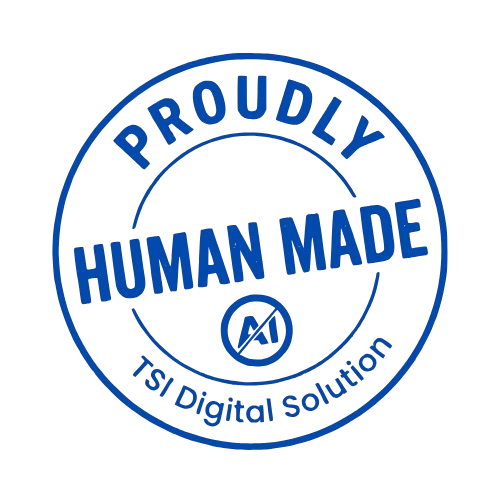
At least eight different organizations are racing to launch their own “No AI” labels – “Proudly Human”, “Human-made”, “No A.I”, “AI-free”, and competing variants. Some are free and honor-based, others require paid audits and AI-detection software. Consumer expert Dr. Amna Khan warns: “Competing definitions of what is ‘human made’ are confusing consumers. A universal definition is essential to build trust, clarification and confidence”.
The Authenticity Arms Race
The moment “imperfection” becomes a trend, it risks being co-opted. Designers may find themselves manufacturing “authentic” flaws rather than embracing genuine imperfection. As brands rush to signal human craft, the line between real and performative authenticity blurs.
How Designers Can Harness Human-Made Design
Embrace the Tactile Rebellion
Creative Bloq’s 2026 trends analysis identifies Anti-AI Crafting as the defining trend of the year (the industry still uses “anti-AI” as a shorthand, but the positive action is human-made design). Graham Sykes, global executive creative director at Landor, explains: “Designers are putting their hands back on the work… literally” – hand-built sets, stitched texture, analogue surfaces, natural light, physical collage, ink, fabric, clay.
Adopt (or Create) a "No AI" Certification
Organizations worldwide are racing to develop universally recognized labels for human-made design. Initiatives range from no-ai-icon.com to ai-free.io to notbyai.fyi, some free and unverified, others requiring paid audits and AI-detection software. Designers can position themselves as leaders by either adopting an existing standard or helping define one.
Master the Aesthetic of Imperfection
Human-made design manifests visually through specific design languages: scrapbook/scanner aesthetics (printing, cutting, and reassembling physical assets), direct flash photography (gritty, unpolished, lived-in), cyber goth (gothic darkness with metallic accents), hand-drawn scribbles, and collage layering.
Build Your Brand Narrative Around Process
The most powerful signal a designer can send isn’t aesthetic but narrative. Show the work. Show the fingerprints. Show the ink that bled too far, the texture that took time to make. Kittl’s 2026 Graphic Design Trends report calls human-made design the number one trend of the year: “After years of AI-smooth perfection and over-polished branding, people are craving proof that a human made this”.
Conclusion
Human-made design is not a passing trend, it is a fundamental realignment of value in graphic design. The backlash against Gucci’s AI campaign was not a social media overreaction but a cultural signal that audiences are actively rewarding brands that invest in human craft.
For designers, the message is clear: AI will not replace you, but the uncritical embrace of AI aesthetics might. The designers who thrive in 2026 and beyond will be those who wield AI as a production assistant while doubling down on the uniquely human: imperfection, intention, and the unmistakable evidence of a hand at work. The future of graphic design is not AI versus human. It is human-made design, augmented.
Frequently Asked Questions (FAQ)
Is the human-made design movement just nostalgia for pre-digital design?
No, it is a strategic response to market saturation, not a retreat into the past. As the Stills Trends Report notes, “design culture in 2026 is rejecting perfection in favor of personality”, a forward-looking recalibration, not a backward-looking retreat.
Will designers who use AI be penalized by clients and audiences?
Not necessarily. Gartner found that while 50% of consumers prefer brands that avoid generative AI, the same consumers are unlikely to punish brands for not using AI. The risk lies not in avoiding AI but in using it without transparency or in ways that cheapen brand value.
How can small studios and freelancers compete without massive production budgets?
The human-made movement actually favors smaller players. Imperfect, tactile, human-crafted work doesn’t require expensive studio setups, it requires creative risk-taking, authentic process, and the willingness to put hands on materials. “Small studios and freelancers are leaning into it as a straight-up business position”, notes design commentator 19AM. “Made by hand. Made slowly. Made by a real person”.
What’s the difference between “anti-AI” and “human-made design”?
Anti-AI is a blanket opposition to the technology itself. Human-made design rejects only low-quality, generic, mass-produced AI content, but embraces AI as a behind-the-scenes production assistant (for retouching, background generation, or rapid ideation) while insisting on visible human authorship and final creative control.
How can a brand or designer credibly claim “human-made” status?
Credibility requires more than a logo. It demands verifiable process: documented workflows, transparent disclosure of any AI use, and ideally third-party verification. As Dr. Amna Khan notes, “a universal definition is essential to build trust, clarification and confidence”. Until one exists, the most credible claims will come from designers who show their work, literally and figuratively.
Ready to Lead the Human-Made Design Revolution?
The window is open, but not for long. Designers who position themselves as authorities on human-made design today will define the conversation for years to come.
Contact TSI Digital Solution today and work with designers choosing imperfection over algorithm.
TSI Digital Solution
(Brand of PT Tripple SoRa Indonesia)
Jl. Sunset Road No.815 Seminyak, Kuta, Badung, Bali – 80361, Indonesia
TSI Digital Solution
(Brand of PT Tripple SoRa Indonesia)
Jl. Sunset Road No.815 Seminyak, Kuta, Badung, Bali – 80361, Indonesia
Copyright © 2022 -
TSI Digital Solution | All rights reserved.